
Mette Ingvartsen: Political Body of Contemporary Theatre. Notes From A Lecture by Illia Razumeiko
The lecture took place on November 23, 2023 within the educational program for people who applied for the Artaud Fellowship, Opera aperta artists, and proto produkciia teams. Illia Razumeiko introduced the performative works, texts, and current research of choreographer Mette Ingvartsen, who works with nudity and sexuality.
Illia Razumeiko is a composer, co-founder of the contemporary opera laboratory Opera aperta in Ukraine, and a doctoral student in the Artistic Research Centre at the Vienna University for Music and Performing Arts.
Mette Ingvartsen is a Danish dancer, choreographer, and performer. For many years, she has been working with the body, nudity, and sexuality as phenomena within art, politics, and society.
We happened upon her performance Skatepark at the 2023 Wiener Festwochen by chance. In many ways, the show was very simple: a real skatepark was constructed on the stage of a theatre, and teenagers and children simply skated, as they normally would on the street. Gradually, this evolved into a dance and choreographic performance. The performers rapped and sang songs. The show revolves around street cultures and how they exist, but it follows a clear structure and choreography. The piece lasts 90 minutes. I really enjoyed the performance and looked up the artist afterward.
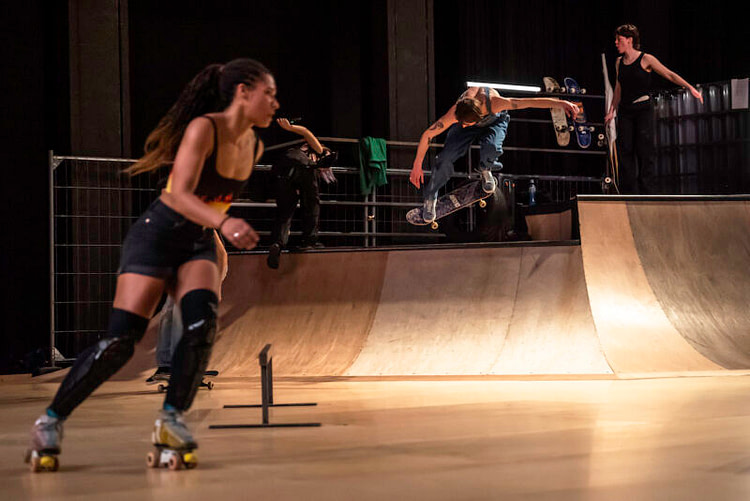
Skatepark, Mette Ingvartsen. Photo by Bea Borgers
Themes of nudity and sexuality have always been present in Western art and society. It’s impossible to pinpoint a specific moment when they first “appeared.” However, attitudes toward these themes have shifted across different eras and cultures.
Mette’s website offers access to her writings and performance videos. She has authored two books. Her central and most encompassing work could be considered her doctoral dissertation titled 69 Positions. In this text, she reflects on her performances and explores the period from the 1960s to the present. Mette has devoted entire cycles to the body: solo and group performances, as well as large-scale theatrical projects like Skatepark.
I first mentioned Mette Ingvartsen at the Khanenko Museum, during a lecture I gave on the theatrical nature of museology. One section of the talk focused on the museification of performance and dance. This topic is quite fascinating, and many people are working on it: among them, choreographer Boris Charmatz, who turns out to be Mette’s partner. He has led various projects in France and the United Kingdom and is also the founder of the Museum of Dance. The museum explores the history of contemporary dance over the past hundred years and seeks ways to preserve, present, and interpret it.
This theme also appears in Mette’s dissertation and projects. She poses a key question: how can one write a history of performance from the 1960s to the present day? Mette frequently references the 1960s and 70s, what is often referred to as the “classical era” of the performative explosion. One of her textual works is Yes Manifesto, written in response to the No Manifesto (1965) by American dancer Yvonne Rainer. In that influential text, Rainer invokes the principles of the “theatre of cruelty” and declares a firm rejection of theatricality and virtuosity.
Mette believes that this time has passed and offers her own situational manifesto. In Yes Manifesto, everything is allowed, but within a new context. From a historical perspective, the piece relates to the avant-garde of the 1960s. Through this manifesto, Mette enters into a kind of dialogue with that era. The practical realization of Yes Manifesto is her early performance 50/50. Its structure is very straightforward: a rock intro, an operatic-melodramatic middle section, and a concluding rock-style transformation. Mette herself describes it as “wearing one’s nudity like a costume and thinking of it as a costume.”
To move on to her next work, it’s worth taking a look at the global map of countries where pornography has been partially decriminalized. On this map, Ukraine and the Vatican appear in red. Among the first countries to decriminalize pornography were Denmark, Belgium, the Netherlands, and the Benelux region more broadly.
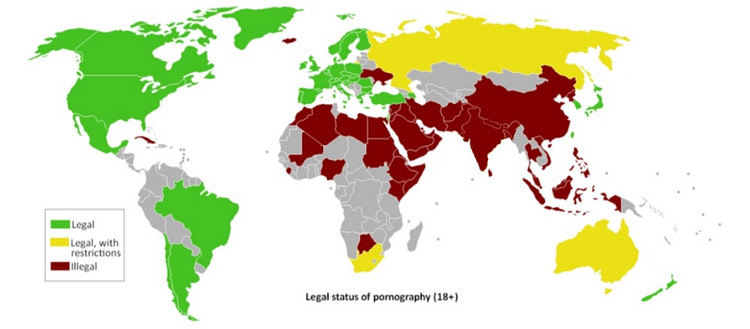
Illustration from Wikipedia
Mette has created several works dedicated to the theme of pornography. One of them is to come. The performance centres on the figure of the Marquis de Sade, who rose to prominence after World War II. Especially during the sexual revolution, his writings inspired numerous operatic and theatrical librettos, as well as film scripts.
to come can be seen as a continuation of 50/50. During the first 20 minutes of the performance, the bodies of the performers engage in a series of choreographic, ironic, and poetic games. Eventually, a “classic rupture” occurs. The piece is structured into three parts and a finale. It’s important to note that this is a work by a Danish choreographer, Denmark being the first country in the world to decriminalize pornography. Mette addresses this history in multiple ways: with humour, sarcasm, poetic reflection, historical retrospection, and direct quotations. The music in the performance draws inspiration from the 1960s.
Her text 69 Positions brings together a wide range of ideas. Beyond pornography, nudity, and sexuality, it explores various aspects of grace and choreography. The first chapter of the book is titled Soft Choreography, in which she reflects on working with audiences:
“What I wanted to achieve in 69 Positions was something else. I wanted to create a choreography that couldn’t exist without the audience. A performance defined by the moods, relationships, and tensions within a particular group of people at a given moment. I wanted to create something with the risk of failure – a fragile situation for which I would ask you to share responsibility with me. I’m not sure whether what I’ve created might ultimately become a fixed script, a choreographic score, or even a set of strategies to rescue myself if the situation reaches an impasse. Still, I think of my relationship with you as a determining factor in 69 Positions, and I’m tying this to the introduction of the text.”
She writes this after producing works that appear classical, theatrical, and carefully constructed, complete with choreographic scores. Mette seeks ways to break out of this structure using different strategies. One such strategy is the lecture-performance, a genre that also emerged in the United States alongside the rise of the dance avant-garde in the mid-20th century.
Another key impetus for Mette’s book was Richard Schechner’s Dionysus in 69, which notably includes photographs from performance works of the 1960s. Many describe that era in the United States as a time of “darkness”, marked by economic hardship and the Vietnam War. In this context, the avant-garde emerged as a reaction to the political and social crisis.
Today, Richard Schechner is a prominent American director, performance theorist, and scholar. In the late 1960s, he staged several groundbreaking avant-garde productions. One of them – Dionysus in 69 – stands out. At the time, Schechner was in conversation with Jerzy Grotowski; they were translating Artaud and drawing deep inspiration from his work. However, Schechner soon shifted into the theoretical realm, becoming a prolific writer on performance theory and contemporary theatre.
Dionysus in 69 is particularly noteworthy despite having been performed only a few times in New York. It remains a point of reference for many theatre scholars: Polish, German, and beyond. The production marked a turning point in theatre history. In the play, Dionysus is literally “born” through the bodies of the performers. The next part of the show unfolds as a large-scale, mystical, orgiastic festival. Performers were fully intermingled with the audience, drawing them into these ecstatic, dance-based rituals. In the finale, Dionysus proclaims himself a candidate for U.S. president, incites the audience to action, leads them into the streets, and greets passersby with a Nazi salute. Mette Ingvartsen takes this play as one of the foundational points for her exploration of sexuality and the naked body.
In her two-hour lecture-performance, Mette speaks about a series of performances from the 1960s, including Dionysus in 69. She delivers the second half of the lecture completely nude. In this state, she dances and discusses serious philosophical and historiographical questions.
Mette sought to appropriate and reinterpret the legacy of the 1960s. Here’s how she articulates her approach:
“As a choreographer and dancer, I wasn’t interested in becoming an art historian attempting to accurately uncover and analyze the past. Instead, I wanted to investigate how the position of the body in our current society differs from its position in the past. I wanted to understand the condition of our contemporary, decentralized, multi-directional, hyperconnected, overstimulated, sensorily manipulated, wounded, and sexualized bodies.
I was interested in constructing a cross-historical body – one that escapes history, originates in the past, but mutates toward the future. A body transformed to the point where it no longer represents history, but becomes a heterochronic phenomenon, sliding between different times, spaces, zones of expression, and textualities.
I realized that to achieve this, I would have to turn my own body into a site of experimentation. I needed to find a way to make my body not one but many, not just a body of multiple genders, sexualities, and politics, but of many characters, figures, narratives, histories, and fictions. I had to multiply the positions my body could occupy and look for ways to destabilize the spectator’s position by actively involving their bodies in my narrative fictions.”
In Mette’s books, one can find lots of information about dance, theatre, pornography, and contemporary culture. Her texts are important not only for choreographers but for anyone who steps onto a stage, attends theatre as a spectator, or thinks critically about art.
The translation of this material was made possible through the Per Forma grant program, implemented by the Kyiv Contemporary Music Days platform with the support of the Performing Arts Fund NL and the Ministry of Education, Culture and Science of the Netherlands, aimed at developing the performing arts sector in Ukraine.
Translation by Yurii Popovych